Natalie Mihalek on food safety and local solutions

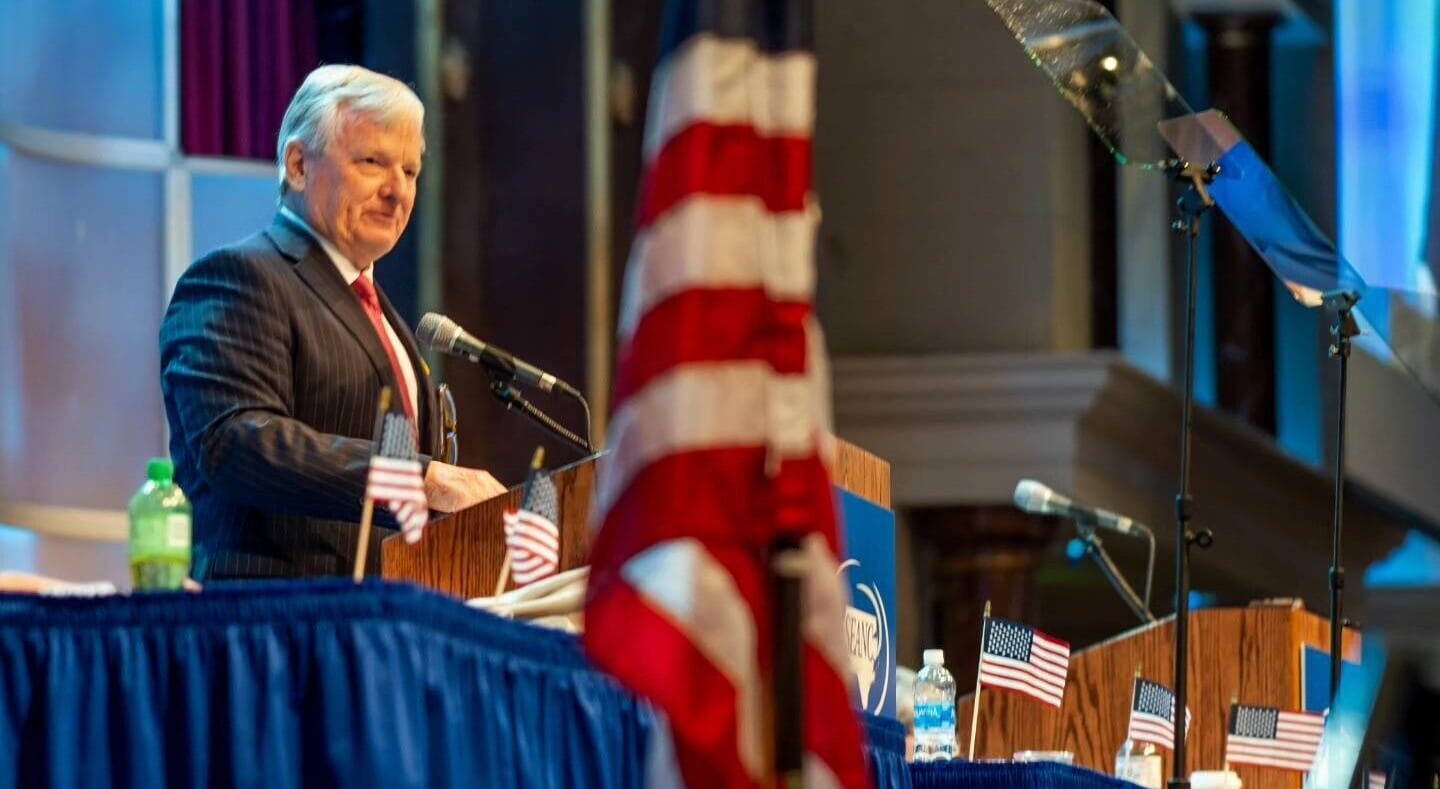
As concerns grow about what’s in America’s food supply, Rep. Natalie Mihalek says states don’t have to wait for Washington to act. The Western Pennsylvania lawmaker, who previously served in the U.S. Navy and worked as a prosecutor, describes food safety as the most bipartisan issue she’s taken on in Harrisburg and explains why stronger coordination across federal, state, and local governments matters. The conversation closes with her reflections on America250 and what it could mean for a civic reset.
I was really drawn to your background. You’re a Navy veteran and a former prosecutor. How do those experiences shape how you govern and make decisions as a legislator? A lot of people are inundated with national news and feel scared, particularly about crime. It’s understandable. I’m sure that shapes how you approach your legislative work.
Rep. Natalie Mihalek: It definitely does. Both experiences prepared me for the legislature in a variety of ways. For my constituents, the biggest thing is that I’m no-nonsense. In the district attorney’s office, you might be dealing with the better part of 100 cases in a given day, so you learn to be efficient with your time and very matter of fact.
I bring that same approach to the legislature. There are a lot of issues that need to be tackled, and I don’t have time for fluff or some of the other things people might expect. I’m there as a pragmatic problem-solver to get things done.
The Navy reinforced that mindset, too. In the military, you have a job to do, and you need to do it as efficiently as possible. Overall, those experiences shaped who I am—as a person and as a legislator—and contributed to that no-nonsense, pragmatic attitude.
I watched some of your videos on food safety, and obviously it’s a huge issue. You’ve pointed out that when Washington won’t, or can’t act, states can lead under our federal system. What sparked your focus on this? And what can Pennsylvania do about rising concerns over ingredients and chemicals in our food supply?
Rep. Mihalek: There’s a lot to unpack, but the short answer is that Pennsylvania can do a lot. I’ve been on a personal health journey for five or six years, looking at ingredients, trying to make better choices, and figuring out what my kids are eating. It can feel like a full-time job reading labels and trying to source certain items from one store and other items from another. You could spend hours on it.
What I found through my research is that even when you want to make good choices, the options often aren’t readily available. Our food system is laden with unnecessary chemicals, dyes, and toxins. Red Dye No. 3, potassium bromate, brominated vegetable oil and propylparaben are a few concrete examples.

As a member of the Pennsylvania legislature, I saw that California passed the nation’s first Food Safety Act in 2023. I was inspired by that and thought, if they can do it in California, we can do it in Pennsylvania. I’ve been working on it for several years now.
I have been working with other legislators on a package of bills titled Healthy PA. Proposals include the disclosure of ingredients that rely on FDA loopholes, prohibiting the sale of products containing Red 40, Yellow 5, Yellow 6, Blue 1, Blue 2 and Green 3 in public schools, banning the use of paraquat and establishing a legal definition of ultra-processed foods.
It’s the most nonpartisan issue I’ve worked on, hands down. Democrats supported it. Republicans supported it. It’s something everybody wants. But we have an uphill battle because the industry is strongly opposed to change, both at the state and at the federal level.
There’s so much information out there, and the issue keeps gaining steam. I know limited-government-minded families are skeptical of an overly regulatory environment, but we’re spending enormous amounts on health care. Why do you think concern about food ingredients and chemicals is growing so quickly? And do you expect it to keep growing?
Rep. Mihalek: People are becoming more aware of what they’re eating and what they’re being exposed to. The fact is, we’re spending about $4 trillion every year in this country on health care, yet we have some of the worst outcomes among developed nations.
If you look at Europe, Australia, Canada, even China, many of those places regulate certain toxic ingredients, herbicides, and pesticides more aggressively. Those exposures can damage the body at a cellular level and contribute to poor health outcomes, which in turn drives the enormous price tag.
You mentioned overregulation. I’m conservative by nature, and I believe in limited government. At the same time, government has a duty to protect its citizens. One way we can do that is by cleaning up the foods we eat and improving how we nourish our bodies. If we do, you’ll see better health outcomes and, on the front end, less overspending on health care.
Shifting gears a bit, politics feels increasingly polarized, especially at the national level. Are there any issues in Pennsylvania where you think progress would come more easily if debates were pushed closer to the local level, instead of being driven by the national news cycle?
Rep. Natalie Mihalek: I’ll borrow from a well-known idea: all politics is local. There’s always an interaction between the federal government, the state government, and local governments—whether it’s a township, a city, or something else. But the megaphone and spotlight are so often on the federal government, even though local government is what affects your day-to-day life.
It’s the most nonpartisan issue I’ve worked on, hands down.
Sometimes the federal government, or even the state government, passes a law that directs a state or local government to do something, and there isn’t much communication before it passes or after. There’s not enough discussion about how it should be implemented or what the end goal was.
We could do a lot better communicating across the different levels of government. That’s how you identify which issues are better handled locally. I might be working on something at the state level, but without talking to local officials, I may not realize they’re better suited to address it, especially if it doesn’t affect every community in Pennsylvania the same way. The same goes for the federal government. We’re a large and diverse country, and a lot of issues do need to be localized.
You touched on this a bit already, but do you have a rule of thumb for when an issue belongs in Washington versus Harrisburg, or even at the local level? Can you share one or two examples where policymaking is better handled closer to home?
Rep. Natalie Mihalek: When you ask that, my mind immediately goes to preemption. In some areas, states are preempted, either because the federal government expressly preempts state action, or because federal law effectively occupies the field.
Most recently, we’ve seen arguments that states are preempted on AI regulation, based on the idea that state-level rules could run into the Commerce Clause, given that many of these companies operate nationally or internationally.
There’s a lot that goes into it, and there are different ways preemption can happen. But as I said earlier, all politics is local. Sometimes local government is better suited to address a problem. That’s part of what I mean about communication: local governments need to step up and say, “I saw you introduced this bill at the state level—here’s how it would affect my community.” Again, more communication is critical.
As we approach America’s 250th anniversary, what are your thoughts on the anniversary for the nation and all of us, really?
Rep. Natalie Mihalek: I’m really excited to see this in real time. I think it’s an opportunity for Americans to come back together. I was talking with a friend earlier this morning, and he said, “Remember the weeks and months after 9/11? You felt invincible. We came together as a nation. We had a shared goal.” He said that feeling is really missing in our society today.
I think America250 has the potential to recalibrate, to remind people why we love America, why we love this country, and why so many of us believe the Constitution is one of the greatest documents ever written. I’m hopeful it can be an opportunity to reset, move away from some of the polarization, and remember that at the end of the day, we’re all Americans. And we’re lucky to be alive at a moment when we’re celebrating 250 years of this democracy.