The unraveling of America’s foundation of rights
G.K. Chesterton once described America as “a nation with the soul of a church.” The Declaration of Independence constructed the United States like a temple by “laying its foundation on” the bedrock of unalienable rights and placing innate liberties conferred by our Creator beyond the bounds of democratic revocation. Governments exist only “to secure these rights,” and any regime that becomes “destructive of these ends” merits its own abolition. These insights restrained tyranny, respected human nature, and empowered citizens with maximum autonomy for generations. Yet today, a bewildering array of new, competing “rights” threatens these “self-evident” truths and undermines the basis of self-government. As economic inflation devalues currency, rights inflation devalues citizenship.
The first dilution of human rights came with the invention of “economic, social, and cultural rights.” Then-presidential candidate Bernie Sanders offered a recent variation in his “21st Century Bill of Rights,” which establishes each person’s “right” to “a living wage,” “quality health care,” “a complete education,” “affordable housing,” “a secure retirement,” and “a clean environment.” In policy terms, this translated into a vast panoply of “free” services whose estimated cost in 2020 ranged between $55 trillion and $97 trillion (not adjusted for inflation). Sanders credited his government-expanding vision to Franklin Roosevelt’s “Four Freedoms” speech, which promised the world “freedom from want” and “freedom from fear.” But American advocacy of this vision crested with a series of memorable Norman Rockwell paintings. In time, this language came to be spoken primarily with a Muscovite accent, as Soviet propagandists sought to counterattack Westerners exposing communist human rights abuses. This new category allowed credulous theorists to assert that “Soviet ideology placed a premium on economic and social rights, such as access to health care, adequate and affordable basic food supplies, housing, and education, and guaranteed employment,” as opposed to “the capitalist West, where the importance of civil and political rights was emphasized.”
As economic inflation devalues currency, rights inflation devalues citizenship.
The next generation of rights inflation sought to establish “collective rights” premised upon membership in discrete social demographics, which are often demarcated by fluid, outwardly imperceptible, culture-specific, or temporary criteria. Migrants’ rights, handicapped rights, et al., “promoted the notion that abused and vulnerable individuals should be protected as members of groups — that groups themselves would be the focus of human rights,” wrote legal scholar Aaron Rhodes, the author of multiple books on the topic. “Thus, over the course of decades, the very notion of equal, individual human rights was upended.”
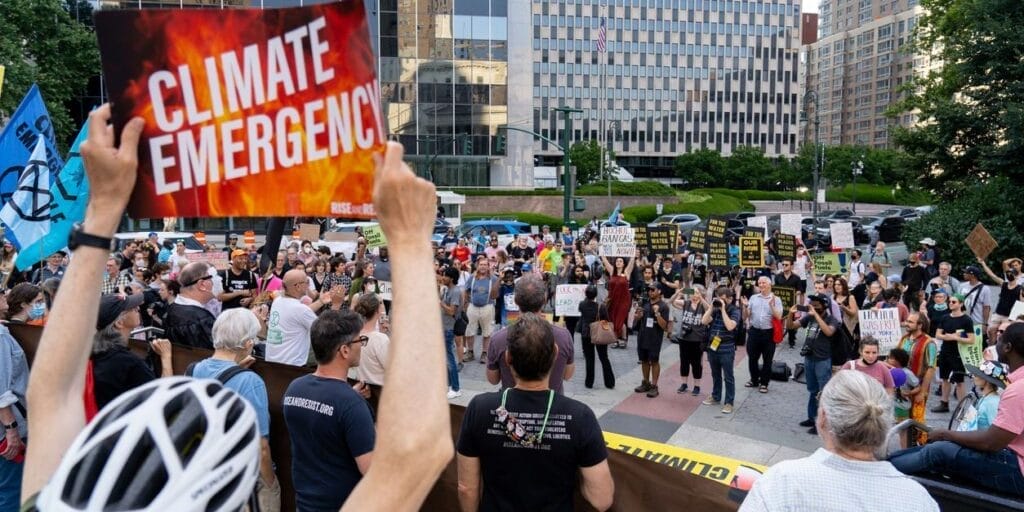
The most recent human rights revolution comes by redefining the category of rights-bearers, as Green ideologues seek to bestow “human rights” on the environment. In June, United Nations High Commissioner for Human Rights Volker Türk challenged legal scholars to develop “models of governance … that recognize the rights of nature.” Yet the movement is already apace. A dozen nations have already granted legally justiciable rights to specific rivers or nature as a whole (personalized as “Pachamama” in the Ecuadoran constitution). In 2014, an Argentinian judge deemed an orangutan a “non-human person” and set her free from a zoo, a ruling the plaintiff hoped would pave the way for “other sentient beings which are unfairly and arbitrarily deprived of their liberty.”
The Founding Fathers’ respect for the “sacred fire of liberty” created a prosperous and spontaneous social order constructed of, by, and for the people themselves, under the watchful eye of Providence. Yet each set of nouveau “rights” erodes self-government. Proponents of “economic rights” induce state control over ever-widening sectors of society, claiming a greater portion of the people’s resources and transferring sovereignty from consumers’ decisions to politicians’ top-down decrees. Invoking “collective rights” permits judges to quash such putatively co-equal rights as freedom of speech or religion. The same unelected judges will define the new category of nature rights one verdict at a time. Perhaps it is no coincidence that Bolivia’s former president, socialist Evo Morales, promoted nature rights or that the 2017 Beijing Declaration on Human Rights averred, “Human rights are the unity of individual rights and collective rights.” Ensconcing newfound categories of rights in international treaties — such as the UN’s International Covenant on Economic, Social and Cultural Rights (ICESCR) or the World Health Organization’s Pandemic Agreement — places decisions one step further away from democratic control.
As government functions drift from protection to provision, they replace self-governance with subservience. The creeping welfare state may “not tyrannize,” wrote Alexis de Tocqueville; instead, “it hinders, it represses, it enervates, it extinguishes, it stupifies, and finally it reduces each nation to being nothing more than a flock of timid and industrious animals, of which the government is the shepherd.” Gradually, it bleeds the capacity for self-government out of the body politic.
The tectonic plates guiding a governmental transformation would dethrone unalienable rights in favor of ersatz “rights” to a share of other people’s labor, a quality that Edmund Burke knew would disqualify citizens from self-government. “Men are qualified for civil liberty in exact proportion to their disposition to put moral chains upon their own appetites” and “rapacity,” wrote Burke. “Society cannot exist, unless a controlling power upon will and appetite be placed somewhere.”
The Declaration of Independence’s unalienable rights and the Constitution’s enumerated powers were meant to act as that controlling power. But ultimately, citizens’ embrace of a new moral framework for government holds the most frightful prospects. “The Revolution was in the minds and hearts of the people; a change in their religious sentiments of their duties and obligations,” wrote John Adams in 1818. “This radical change in the principles, opinions, sentiments, and affections of the people, was the real American Revolution.” Rights inflation threatens to touch off a new revolution from above—a second founding, or unfounding, of the United States as we know it.

Thankfully, President Donald Trump appears to sense the nation drifting away from the American creed. The Trump administration announced in November that the State Department’s national human rights reports will evaluate only those rights “given to us by God, our [C]reator.” This builds on the first Trump administration’s report from the Commission on Unalienable Rights and echoes Vice President J.D. Vance’s warning at the Munich Security Conference about “the retreat of Europe from some of its most fundamental values,” particularly the “backslide away from conscience rights” and free speech. Europe promptly verified Vance’s concerns by prosecuting pro-life advocates for “conducting a silent vigil” and convicting more than 1,000 British citizens over social media statements. Police in England and Wales make 30 arrests a day, or more than 12,000 arrests a year, for posting online messages or other forms of communication that provoke the recipient’s “annoyance,” “inconvenience,” or “anxiety,” according to The Times of London.The uptick in thoughtcrime prosecutions as the number of violent or sexual crimes successfully closed declines shows that new ideas, such as the freedom from “annoyance,” have displaced the right to life, liberty, and the pursuit of happiness.
Rights inflation seeks to rest the republic on the silt of economic interventionism and identity politics. Both dissolve the average person’s capacity to exercise the freedoms long recognized by Western civilization: the right to speak one’s mind freely, to practice one’s religion, to acquire and dispose of property reasonably freely.
Unless America gets its house in order by respecting its citizens’ unalienable rights, the day may come when its citizens recount how “the rain descended, and the floods came, and the winds blew, and beat upon that house; and it fell,” says the Bible. “And great was the fall of it.”
V. Rev. Benjamin Johnson (@therightswriter) is an Eastern Orthodox priest with more than two decades of experience as a conservative editor, commentator, and radio talk show host. His views are his own.