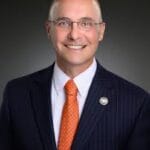
Mark Wright on faith, economic growth, and Louisiana’s future

Louisiana Rep. Mark Wright, a Republican from the 77th District in St. Tammany Parish, has built a reputation as a policy-minded lawmaker focused on economic growth, tax reform, and the state’s long-term competitiveness. Elected to the House in 2017 after serving on the Covington City Council, Wright also brings private-sector experience from his work with the American Waterways Operators. His legislative interests have spanned maritime policy, infrastructure, regulatory reform, and new technologies such as cryptocurrency. He recently spoke with American Habits Editor Ray Nothstine.
What do you love most about the people in your district and about Louisiana? And what gives you hope for the future?
Rep. Mark Wright: I wouldn’t limit it just to my district, because what I love is true of Louisiana more broadly. It’s home, and you naturally have a deep affection for home—for family, friends, and the culture and traditions you grew up with.
What I’ve always embraced most, and what gives me the greatest hope for Louisiana, is our faith. We have a deeply faithful population—Catholics, other Christians, and people of faith from many backgrounds. It’s always been a defining part of who we are. I see it every day when we open in prayer at the legislature. That moment is welcomed and embraced by everyone.
Faith matters, and family is woven closely into it. When people live out their faith, you see it clearly in their family, which is the first unit of society. And I think you see that across Louisiana.
You see it in the way people gather around food, because that’s such a communal part of life here. You see it in sports, too. People love football and other sports not just because it’s entertainment, but because it’s something they share. When the Saints are winning, that’s all anybody wants to talk about. The same is true with LSU football and the tailgating culture around it, which is some of the best in the country.
The other thing that gives me hope is that Louisiana has the building blocks of a strong economy. Oil and gas, the Mississippi River, shipping, and agriculture. Those are foundational industries. We also have growing sectors in the digital economy and other emerging areas.
Louisiana is known for those core economic industries as well as entertainment and celebration like Mardi Gras and everything that comes with it. Those will always be important parts of our future.
I know your statewide offices are not up this year, but what do you think is the biggest governing test Republicans need to pass to keep public trust?
We’re starting the second half of the term, and that matters because the governor came in and moved very hard and very fast, including several special sessions.
As for these next two years, I wouldn’t say there’s just one singular focus, because issues like insurance and crime remain huge priorities. We’ve passed bills in both areas, but with some of them—especially on insurance—you must give it time to see how the changes play out before deciding whether to do more, do less, or adjust. That’s an area where people continue to feel real pressure, particularly with auto and property insurance costs.
On taxes, we had a major tax reform session the fall before last. We made significant changes; the kind of changes people had been talking about for a generation. And it’s not over. Ultimately, the goal would be to reach zero income tax, or at least to a very low-income tax. We’re moving in that direction, but just as importantly, we made major changes to taxes that affect business investment.
Those reforms helped put Louisiana in a much stronger position. Groups like ALEC and the Tax Foundation recognized that Louisiana had created a top 20 business tax environment, which is a step forward. We had some taxes that were widely seen as bad for growth—inventory taxes, for example—but many parts of the system had become dependent on them, and making those changes required moving a lot of pieces at once.
Because we have a balanced budget requirement, we also had to keep the budget in line, which meant setting the sales tax a little higher than we would have liked. Next year is a fiscal session, and I think what you’re hearing now is that, depending on how things go over the next year, there will be an effort to reduce income taxes further as we move toward the next term, and reduce the sales tax.
The challenge is that so much in Louisiana depends on federal support and other fixed budget realities. That makes it harder for big reforms all at once.
You receive 51% of your money from the federal government, right?
Rep. Wright: We have a lot of poverty—generational poverty—so our budgets are largely federal pass-throughs. That’s how it works. The money is going to reach people one way or another; it simply comes through the state, and we administer it. So, you can’t just cut departments in half, because a lot of what they do is tied to federal entitlements.
To change that, we must think in terms of growth, and we’re starting to see it happen. We just landed four potentially major generational investments to help accelerate that.
The Port of New Orleans is moving forward with a new container terminal that could triple its volume and dramatically expand what we can do in deep-draft shipping.
Farther up the river, Hyundai is developing a steel plant with the federal government—a roughly $5 billion project. That’s the kind of investment that can reshape an area, especially in one of the poorer parts of the state.
Then you have Meta building what is expected to be the largest data center in the world in Louisiana. Amazon has announced a similar project in the Shreveport area. These are enormous investments that will be built out over the next five to 10 years.
In my view, that’s what will begin to solve more of our long-term challenges. Louisiana has dealt with out-migration for nearly a decade. But these kinds of projects will bring people in, create jobs, and generate the kind of growth we need to better address dependency issues.
On top of that, our energy costs are low. The liquefied natural gas export market has become a major force in the global economy.
I’ve been to Lafayette, and I was amazed by some of the homes down there. You can tell there are people in the oil industry. I was like, “Man, there’s some nice homes here.”
Rep. Wright: Yes, and that’s not new. In Plaquemines Parish, at the mouth of the Mississippi River, Venture Global exports LNG from a facility that, when it was built a few years ago—and likely still today—was the largest construction project in the world.
It was built to create an export terminal and everything needed to ship LNG. Guess what? They have now applied to the federal government to build a second one that’s just as big. They’re going to double that sucker. What’s crazy is, on the other side of the state, in Calcasieu Parish, right around the Texas border, you have three export terminals.
We are essentially the center of the liquefied natural gas movement. What’s happening is that, after Russian natural gas supplies into Europe were disrupted, much of that demand is now being met through Louisiana.
It’s far safer than relying on Russia. It’s great for the world and huge for Louisiana. It’s the kind of slow-moving shift that people will look back on and say was the beginning of a monumental change.

You’re term-limited, and you’re going to be running for a different position. What are one or two big goals that you feel like you’ve accomplished in the legislature?
Rep. Wright: I’m proudest of the issues I worked on early. In many cases, I couldn’t get them passed right away, but two or three years later others began to pick them up, and eventually those changes were made.
One area where I was able to help see that work through was maritime policy. I was the final author of the Port Investment Commission bill, which created a more unified investment strategy for Louisiana’s ports. We have 36 ports statewide, and the five major ports on the Mississippi River together form the largest port complex in the world.
Before that, investment was much more fragmented and largely depended on what each individual port was doing. At times, the ports were even competing with one another, which is not what you want when state dollars are involved. This helped move us toward a more coordinated, strategic approach.
We also established the Louisiana Maritime Academy, a maritime school in Thibodaux at Nicholls State. There are only about seven in the country, so this gives Louisiana a real opportunity to build on one of our core strengths. Maritime is already a huge part of our economy, especially on the brown-water side, and this positions us to become a recognized leader while further developing the workforce to support it.
I’ve also worked on about five cryptocurrency-related bills. None of them were game changers by themselves, but together they helped lay the groundwork for Louisiana to embrace that industry.
Are you a proponent of cryptocurrency?
Rep. Wright: Yes, but not in the way most people think about it. I’m less interested in Bitcoin itself than in the underlying utility—faster payments, tokenized transactions, and smart contracts. I think that technology is going to significantly change the way business is done, and I’ve worked on legislation to help position Louisiana to adapt.
I’ve also spent a lot of time on regulatory reform. Louisiana’s regulatory burden is heavier than many people realize, and those costs can be especially hard on working families and small businesses. I’m proud that we were able to bring more attention to that issue and start building momentum for change. I’d put that alongside my work on tax reform and aviation-related tax policy as areas where I feel I made a meaningful contribution.
As America approaches its 250th anniversary, what are Americans still doing right, and where do we most need to improve?
Rep. Wright: I think there’s a lot of concern about where the country is in some respects, but I also think you’re seeing a pushback against cultural trends that many people believe are anti-family and anti-faith.
At the same time, one of the things America still does exceptionally well is innovate, and that comes directly from freedom. If you look at the things this country is known for—the internet, AI, and so many other breakthroughs—they all come from a free society where people can create and take risks.
I also think we have shown a willingness to stand for freedom around the world. That does not mean we should be eager to start wars. That is not something I want to see. But when America is willing to defend what is right and stand against authoritarianism, it sets an important tone globally.
The world will never be perfect, and there will never be a utopia, but I believe America can still be a light for freedom and a country that others respect for standing on principle.