From Michigan to Washington: Tom Barrett on the values that endure

U.S. Rep. Tom Barrett reflects on the Founders’ vision, the American spirit, and the responsibilities of a free people.
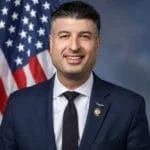
Congressman Tom Barrett represents Michigan’s 7th Congressional District in the U.S. House of Representatives. A lifelong Michigander and 22-year U.S. Army veteran, he served in Iraq, Guantanamo Bay, Kuwait, and along the Korean DMZ before returning home to advocate for fellow veterans. Barrett later served eight years in the Michigan Legislature, where he became known for his work on veterans’ issues, tax relief, and infrastructure. He now brings those same commitments to Congress, representing a diverse district that stretches across mid-Michigan. He recently spoke with American Habits Editor Ray Nothstine.
As the Declaration’s 250th anniversary approaches, many hope it can spark a sense of civic renewal. In your view, what enduring principles are most worth recommitting to as a nation right now?
Congressman Tom Barrett: The Declaration of Independence laid out values that were then carried into the Constitution and continue to guide our governing principles today. At the heart of those values is a fundamental understanding of where our rights originate.
Throughout most of human history, people believed that rights were granted by whoever held political power. A governing authority could decide which rights existed and which did not. What was revolutionary about the Declaration was its insistence that our rights come from God and that they are inherent in our creation, not bestowed by any government.
Because our rights exist independent of government, the role of government is to protect them, not define them. That idea was extraordinary and unprecedented in history. And over the past 250 years, this experiment has demonstrated that when a nation truly takes this principle seriously, when it recognizes that rights are fundamental, inherent, and innate, remarkable human flourishing follows.
As a former state legislator, you’ve seen firsthand how state government works. How does that experience influence the way you view federalism and your responsibilities now as a member of Congress?
Barrett: I served eight years in the Michigan Legislature before coming to Congress, and I really value that experience. It grounds me in the understanding that, at the end of the day, the primary responsibility for governing doesn’t rest at the federal level. It rests with state and local governments—the levels closest to the people. Our Constitution affirms that through the Tenth Amendment.
Sometimes people approach me with issues that are actually state or local concerns. Often they’re well-meaning citizens who may not think about federalism every day. They’ll ask me to help resolve a zoning matter or a township dispute, and I must remind them: you do not want your member of Congress making zoning decisions for your community. That’s not how our system is designed.
The same goes for state-level responsibilities like professional licensing or other regulatory matters. These things are best handled where government is closest and most responsive to the people affected by those decisions.
At the federal level, our responsibilities are different—and they should be. National defense, border security, immigration enforcement—those are federal duties. Overseeing our military and protecting the nation are central to what we do. But we should not be in the business of making granular decisions that belong to state or local officials. That’s the balance federalism was designed to preserve.
What are a few of the biggest ways the federal government is overstepping today in ways that undermine the Founders’ vision expressed so well in our Tenth Amendment?
Barrett: Over time, we’ve seen a steady, incremental expansion of federal power. The tentacles of federal overreach now extend deeply into the economy and into areas the founders never intended Washington to control.
We see this in licensing and permitting, especially around infrastructure. I serve on the Transportation and Infrastructure Committee, and one of our biggest challenges is the permitting process. Federal and state agencies often end up fighting with each other over approvals. That means taxpayer dollars on one side of the dispute, say, an infrastructure project, are being used to fight taxpayer dollars on the other side, whether it’s a federal agency, a state permitting office, or an environmental review body. In the end, taxpayers fund both sides of the same fight.
We’re working to streamline this process. A good example: if the endangered “spotted tree butterfly” wasn’t harmed by the bridge that’s been standing in your community for decades, we shouldn’t have to conduct an entirely new endangered species review just to replace that bridge at the end of its life. The butterfly has clearly adapted to the existing structure.
These unnecessary layers of regulation drive up costs. In a recent committee hearing, I asked an industry leader why infrastructure costs have risen far faster than inflation for decades. He said the single biggest driver is permitting delays. When a project is sequenced and ready to go—materials purchased, labor arranged, equipment staged—and then everything gets halted for a permit issue, the disruption is enormously expensive.
So this is one area where state and federal governments often work at cross purposes, and the result is inefficiency that harms taxpayers at every level. Streamlining these processes is essential to restoring a healthier balance of federalism.
We recently did an energy issue and talked to multiple people in government and at energy companies and they all complained about the permitting process to get new sources of energy launched. Most of the blame seemed to be with the feds. It’s a recurring frustration.
Barrett: Absolutely. That’s another clear example of how permitting has gotten out of control. We see layers of federal environmental regulations and expectations piled on top of separate requirements imposed by individual states. Even when we make progress at the federal level to streamline or relax some of these burdens, as we have under the current administration, states can still move in the opposite direction.
In Michigan, for instance, the state has adopted aggressive green energy mandates that are completely unrealistic. Those policies create significant obstacles for energy production and ultimately drive-up costs. So even if the federal government reduces regulatory barriers, state-level mandates can recreate the same problems all over again. The result is higher energy rates for consumers.
Let me ask you this, are there particular strengths or values in the Michigan communities you represent that you think reflect the ideals of the Founders? What is it about the people in your district that makes them inclined toward self-government?
Barrett: There are incredible people in my district. And honestly, I don’t believe that spirit is unique to my district; it’s something deeply American. But Michigan’s 7th Congressional District really is a remarkable cross-section of the country. We’re a true 50–50 district politically. We have the urban center of Lansing, the university town of East Lansing, the surrounding small towns, and rural communities beyond that. We have agriculture, industry, really all the different facets of American life represented right here. It’s a microcosm of what makes this country so unique and special.
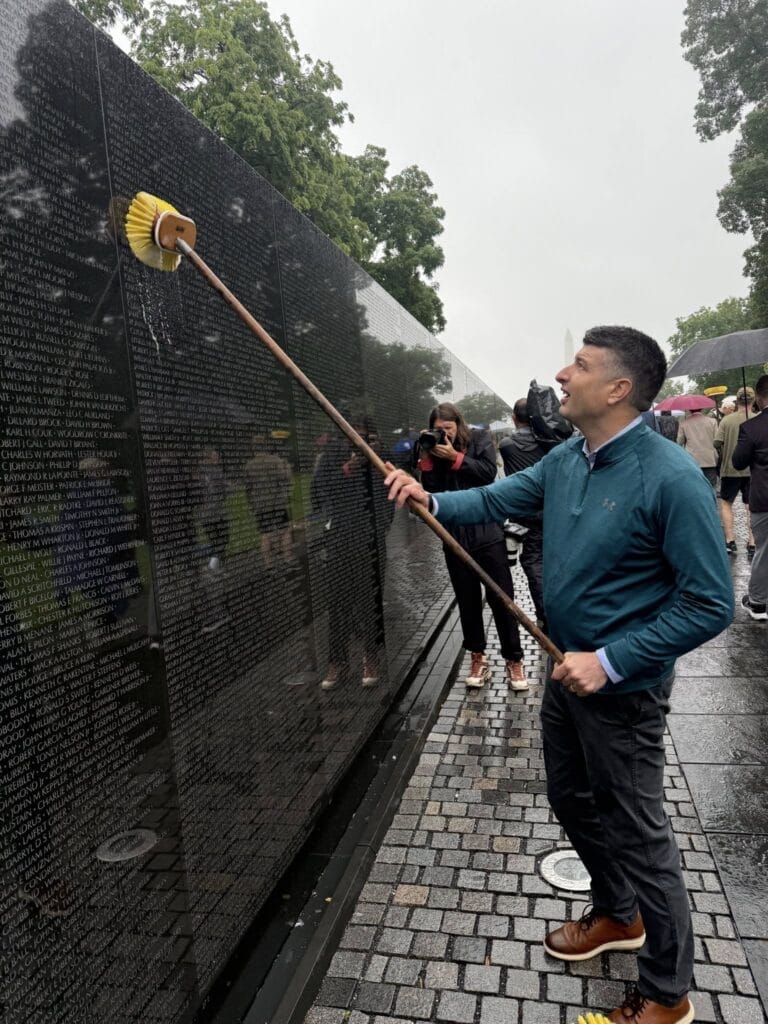
You see the ideals of self-governance especially clearly in the rural parts of the district, where people are a bit more removed from the bustle of larger communities. They take on more themselves, they rely on personal responsibility, and they look out for one another. There’s a strong culture of neighbors helping neighbors, people stepping up without needing to be asked. That sense of community care is deeply tied to the Founders’ vision of a self-governing people.
One of the moments I’ve been most proud of in my decade of public service involved a young man from my own small town. About four years ago, the remains of Ensign Francis Flaherty, who lost his life aboard the USS Oklahoma during the attack on Pearl Harbor, were finally identified through DNA evidence after nearly 80 years. He had been awarded the Medal of Honor posthumously for giving his life to help evacuate fellow sailors.
Flaherty was from Charlotte, the town where I live now. When Flaherty’s family had the Department of Defense repatriate the remains for burial in our local cemetery, the community response was extraordinary. No one alive today knew him personally, yet the entire town lined the streets as his motorcade passed. Thousands came. A Navy admiral delivered the eulogy. It was one of the most moving displays of patriotism and gratitude I’ve ever witnessed.
As we recently marked the anniversary of Pearl Harbor, I was reminded of that moment, and of how many communities across America show this same spirit. Small towns everywhere have stories like this, examples of people honoring service, sacrifice, and country. It makes me incredibly proud not only to be an American, but to represent a district that embodies those values so powerfully.
Looking ahead to the next 50 years, what gives you the most optimism about America’s trajectory and what are your biggest concerns?
Barrett: There’s certainly a long list of concerns. I sometimes tell my congressional staff that we’re never going to work ourselves out of a job, there will always be problems to solve, and Americans will always disagree about how best to solve them. But I try to keep that in perspective. Our founders didn’t claim they were forming a perfect union; they said we were engaged in the pursuit of a more perfect union.
That reminds us to approach public policy with humility and purpose. We know perfection isn’t attainable, government is made up of human beings, and we are inherently flawed. But we can strive to improve over time and move closer to the aspirations the Founders laid out, recognizing the sacrifices they made to give us the freedom to debate issues—big and small—that shape our national life.
It’s easy to grow weary of politics today given the constant back-and-forth. But if we zoom out, we should be grateful that we live in a country where political disagreement is not only tolerated but protected. Across thousands of years of human history, that has been extraordinarily rare. In many places, even today, people cannot speak freely or challenge their government without fear. Our ability to do so is both a blessing and a responsibility.
Of course, people sometimes abuse that freedom, but that doesn’t diminish its value. It simply means we each have a personal duty to use it responsibly. I often remind myself that I cannot control the behavior of others, but I can only control my own. I can choose how I speak, how I act, and the example I set, and I can hope that it positively influences others, even knowing I can’t control whether they follow that example.
That sense of individual responsibility, combined with the freedom to participate and disagree, is what ultimately gives me optimism. If we remember those principles and act on them, I believe we can continue moving toward that “more perfect union.”
You had a family member who helped make sure that “Under God” Is in our Pledge of Allegiance. I feel like I should ask you about that.
Barrett: My great-grandfather was elected to Congress in 1934. He represented a district on the east side of Detroit and the Grosse Pointe area. In 1953, he sponsored the bill that added the words “under God” to our Pledge of Allegiance. The purpose was to offer a clear rebuke of communism. His view was that if you sever America from the values that root our nation “under God”—and from the belief that our rights come from a higher authority—then you reduce the value of the individual to nothing more than a grain of salt.
He described this in his floor speech when the bill passed, calling it the “unbridgeable gap” between America and the communist adversaries we faced in the Cold War. The following year, on Flag Day in 1954, President Eisenhower signed the bill into law. That moment has always been a point of pride for my family.
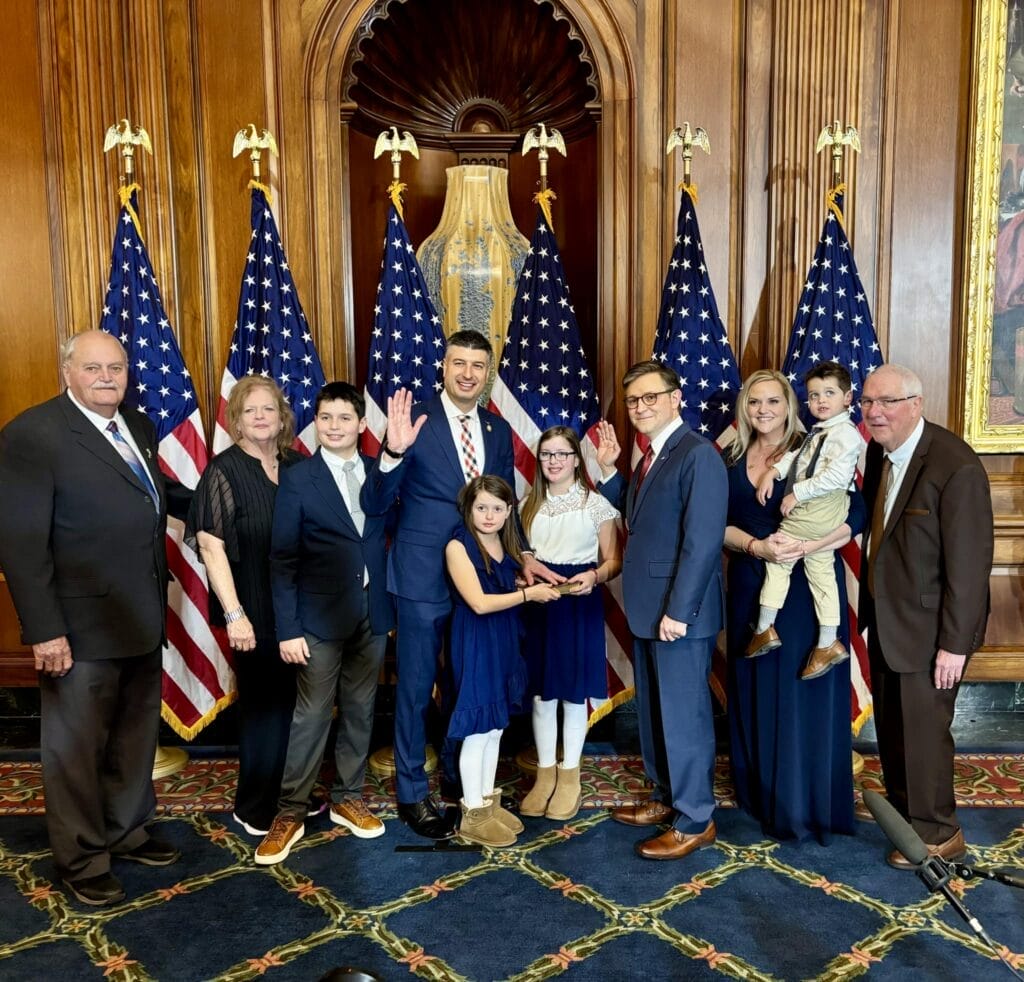
When I was elected to Congress last year, a series of events allowed me to move into the same office my great-grandfather once occupied. I was able to bring my family there, and it has been incredibly meaningful. I have his photograph on the wall—a picture taken shortly after the bill was signed—with my dad and two of my uncles as children. In the photo, he’s showing them the pen President Eisenhower used to sign the legislation. We have a copy of the signed bill framed beside it.
For me, it’s a daily reminder that the decisions we make in public office can have a legacy that lasts far beyond our own lifetimes. It’s an incentive to choose wisely. No one is going to remember how you voted on some procedural amendment that feels important in the moment. But they will remember the decisions that have a lasting impact on the country, decisions that people may still be talking about 75 years from now.