Five American elections that changed the political landscape

A look at the last 50 years of elections that forged today’s political coalitions
American history is full of elections that reshaped the nation. For this piece, I’m narrowing the focus to the past 50 years, the era when today’s coalitions, institutions, and media environment take on a more modern form.
The election of 1864 may be the most consequential and dramatic contest on the books, but the farther back you go, the harder it becomes to draw precise parallels to our modern political scene. These five elections, by contrast, didn’t just pick leaders. They reordered policy, redefined parties, and changed American views and expectations of government.
1980 — The Reagan Revolution begins
Coming out of post-Watergate Democrat dominance, Ronald Reagan and the Republicans mounted big wins across the board, securing the U.S. Senate by picking up 12 seats, going from a 41-seat minority to a 53-seat majority.
Birch Bayh, George McGovern, and Frank Church were some of the notable Democrat senators that lost reelection. Bayh in Indiana was replaced by Dan Quayle, who at 33, remains the youngest person ever elected to the U.S. Senate from Indiana.
While still in the minority, Republicans picked up 34 seats in the U.S. House and so-called conservative Democrats or “boll weevils” helped usher in the Reagan agenda.
The New Deal coalition eroded further, accelerating Democrats’ shift left on many social issues. With Reagan in the White House and Republicans controlling the Senate, the center of gravity shifted toward tax cuts, deregulation, and a much tougher Cold War posture, while skepticism of “big government” became a defining theme of the 1980s. The coalitions and rhetoric forged in that contest still shape how both parties talk about the economy and culture.
Down-ballot: Republicans went from full control of 11 state legislatures to 15, a modest figure by today’s standards, where they control nearly twice as many. Perhaps of note, Bill Clinton lost reelection as governor of Arkansas but would retake the state two years later, serving as governor until becoming president in 1993.
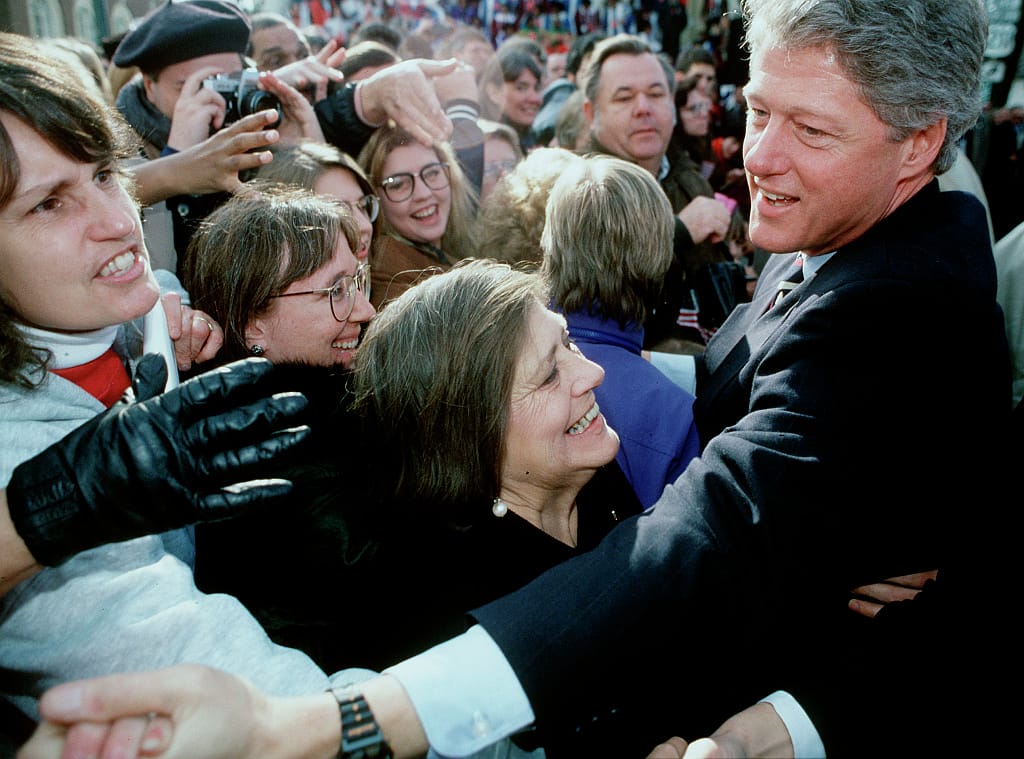
1992 — “The Comeback Kid” and the economy
Democrats had lost three elections in a row for the presidency and Clinton’s move to the political center as a “New Democrat” was enough to win during a recession. As political strategist James Carville famously put it: “It’s the economy, stupid.” Clinton finished second in the New Hampshire Primary after a spate of scandals and questions about his character, earning him the political nickname “The Comeback Kid.”
Clinton didn’t win in a normal two-party race: Ross Perot captured 19% of the vote, an extraordinary modern third-party showing that revealed a growing anti-establishment appetite, especially around deficits, trade, and the sense that neither party was being straight with the public. Some conservatives argued George H.W. Bush had drifted from the Reagan-era coalition, especially after campaigning on the ‘Read my lips: no new taxes’ pledge and then signing the 1990 budget deal that raised taxes. The broken pledge became a lasting symbol of betrayal for parts of the Republican base and fueled intraparty backlash heading into 1992. Pat Buchanan’s strong showing in the New Hampshire Primary and convention speech revealed fractures the Republican Party is still dealing with today.
Down-ballot: 1992 wasn’t a clear wave election: Democrats made modest gains in gubernatorial races even as many states remained politically mixed. Jim Hunt wrestled North Carolina back in the Democrat column in the governor’s race.
1994 — The Republican Revolution
Clinton’s unpopularity and Democrat overreach created one of the biggest wave elections in modern history. The 1994 midterms flipped the U.S. House and Senate and produced sweeping down-ballot gains that reshaped American politics for a generation.
Tom Foley (D-WA) lost his U.S. House seat in 1994 to Republican George Nethercutt during the Republican Revolution, an upset widely seen as a symbol of the anti-incumbent mood and punishment dished out for much of Congress. Foley’s defeat was historically rare: the last time a sitting Speaker lost re-election was 1862, when Galusha Grow was voted out of his Pennsylvania seat. Republicans more than doubled the number of states where they fully controlled the legislature, from 7 to 15.
Down-ballot: Republicans took control of 20 state legislatures and hadn’t held a majority of governorships since 1970. They went from controlling 20 governors’ mansions to 30. By picking up 472 state legislative seats, Republicans won control of a majority of state legislatures for the first time in 50 years.
Future Republican President George W. Bush defeated Ann “Ma” Richards in the Texas governor’s race, which was considered one of the biggest upsets of the cycle. In Florida, Lawton Childs narrowly defeated Jeb Bush, and Bush would later win two races for governor there, but many political experts at the time predicted Jeb would win and his older brother would narrowly lose.
2008 — Barack Obama and the rise of political messianism
The Great Recession helped propel Barack Obama to an easy victory over John McCain in the presidential race. Obama predicted during his nomination speech that this was “the moment when the rise of the oceans began to slow and our planet began to heal.” Actor Jamie Foxx went so far as to call Obama “our Lord and Savior.”
Obama’s victory, historic in its own right, also showcased a new model of turnout focused on heavy use of social media and digital turnout operations, while Democrats’ gains briefly created the governing runway for major policy change. Those legislative goals were stunted by the Republicans picking up a whopping 63 seats in the U.S. House during the 2010 midterms.
And if one wants to go down a controversial election rabbit hole, Al Franken’s razor-thin defeat of Republican incumbent U.S. Senator Norm Coleman in Minnesota is sure to make your head spin.
Down-ballot: Democrats picked up three legislative chambers and also won the Missouri governorship.
2016 — Donald Trump, populism, and realignment
In what was supposed to be the election that broke the “glass ceiling” of all male American presidencies, Donald Trump stunned much of the nation and Hillary Clinton with his clear Electoral College win. The so-called “Blue Wall” ended up shattering when Trump carried Michigan, Wisconsin, and Pennsylvania.
Trump’s breakthrough was also a signal that the parties were sorting along some new fault lines, less about the old left-right economic spectrum and more about education, culture, and place. In 2016, the “diploma divide” widened: college-educated voters leaned sharply toward Democrats while non-college educated voters leaned more Republican, a shift that helped redraw the electoral map into an even more pronounced rural and urban divide. And Trump’s brand of populism, anti-elite, anti-establishment, and openly skeptical of trade and immigration, gave that emerging coalition a governing message, turning resentment toward institutions and “politics as usual” into a sometimes organized theme often called “The New Right.” In that sense, 2016 didn’t just produce an upset Electoral College outcome; it clarified the realignment already underway and made America’s governing brand of conservatism more populist, and with a harder edge, given some of Trump’s heated rhetoric.
Down-ballot: Republicans picked up three governor races in Missouri, Vermont, and New Hampshire. Democrats secured a flip in North Carolina with Roy Cooper narrowly defeating incumbent Gov. Pat McCrory. There wasn’t a dramatic shift in state legislative bodies, but Republicans did pick up the Kentucky House for the first time since the 1920s and Democrats took control of both chambers in Nevada and the lower chamber in New Mexico. The Alaska House also flipped from Republican control.
Ray Nothstine is editor of American Habits.