
A few thoughts on education and School Choice Week
Of all the tyrannies on human kind
The worst is that which persecutes the mind.
—John Dryden
I’ve been so busy that I had to be reminded that it’s School Choice Week the other day. I’m not going to revisit all my thoughts on the topic, but I do want to highlight some of my favorite words from Russell Kirk, which provide a great framework for thinking more deeply about education:
The primary purpose of a liberal education, then, is the cultivation of the person’s own intellect and imagination, for the person’s own sake. It ought not to be forgotten, in this mass age when the state aspires to be all in all, that genuine education is something higher than an instrument of public policy. True education is meant to develop the individual human being, the person, rather than to serve the state.
I included Kirk’s words in a lecture I gave at Thales Academy last year at a conference on educational freedom. It covers more broadly my views on education, particularly regarding the problems of federal overreach.
My dad was an Air Force pilot, so I moved around a lot growing up. I went to bad public schools and I’m sure a few good public schools. I was young, but public schools in New Hampshire seemed pretty good. Hawaii was atrocious. I spent a couple of years in private school in Egypt in eighth and ninth grade, and it was academically rigorous. Hawaii didn’t prepare me for it. After Egypt, I went to public school in Mississippi, which was a major culture shock. But I had a couple of teachers who really helped ignite a love for learning.
I think I received a pretty solid liberal arts education at Ole Miss. I was a political science major because I thought I wanted to be a political consultant after reading “Bare Knuckles and Backrooms” by Ed Rollins—hilarious book by the way. I ended up minoring in history, it was a lot more interesting, and anytime I had an elective I always took extra classes in the history department. Professors James J. Cooke and Charles Eagles helped me learn how to write. The political science professors seemed less concerned about that. Cooke and Eagles carved up my papers in red ink, and I steadily improved. There are so many books I could cite but I stumbled on the American civil rights leader Rev. Andrew Young’s “An Easy Burden” in the university library doing research and it planted the seeds for a different kind of future for me.
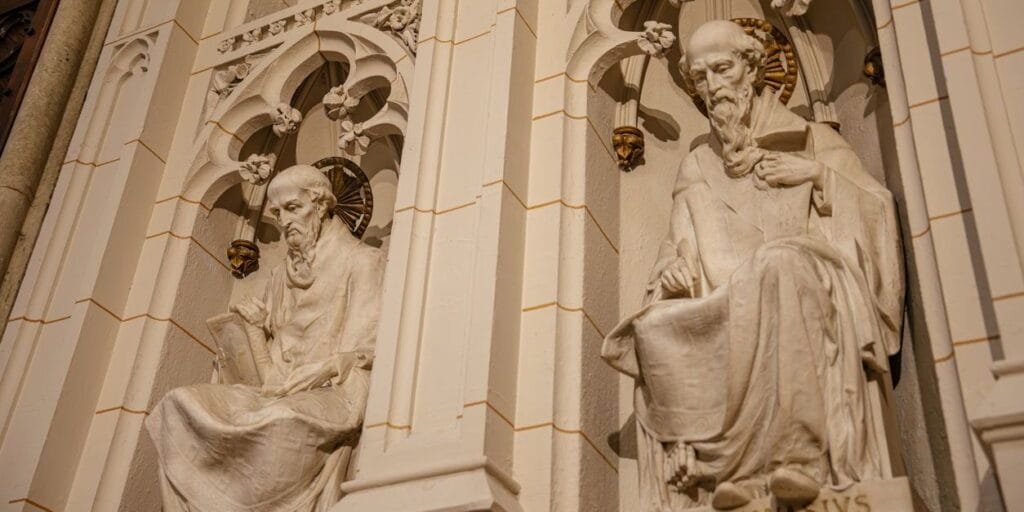
However, I’m not sure I really received a real education until going to seminary in Kentucky at Asbury. I remember reading “On the Incarnation” by Athanasius and being completely in awe. It answers the fundamental questions, “What does it mean to be human?” and Cur Deus Homo, or “Why did God become human?” And rebellion against those answers, I think, is at the root of many of the ideological schemes we face.
I like to joke that if I’d gotten a classical education, maybe I’d be a neurosurgeon at Johns Hopkins. Then I remember I gave blood—twice—for extra credit just to squeak by basic biology in college.
I only offer up this autobiographical information to make a simple point: where you learn matters, and who teaches you matters. When I look back at my own education it is when I had options that learning really took off for me. There is no doubt school choice would have benefited me being ripped from good schools and placed in very bad schools. The bad schools stunted some academic achievement and growth. I don’t think of school choice as primarily some kind of policy preference, but simply as giving young people the freedom to pursue an education that truly forms the mind and imagination in a way that points to greater truths. Why would we ever want to prevent that?
—Ray Nothstine
— The Federalism Beat