The Declaration as a guide for our time: A conversation with Steven Skultety

Steven Skultety is the director of the Declaration of Independence Center for the Study of American Freedom at the University of Mississippi (Ole Miss). A member of the faculty at Ole Miss since 2006, he is the chair of the Department of Philosophy and Religion at the University in Oxford. He recently spoke with American Habits Editor Ray Nothstine.
Your center at Ole Miss is named after the Declaration. Why is this document still so relevant in our present era? What core ideas should we be paying attention to most in 2025?
Steven Skultety: I think the first thing to remember is that it’s called the Declaration of Independence. It’s not called a description of independence. The document does identify a set of core principles. The most basic point it makes is this: as Americans, we will fight to make a change if we don’t think we’re being treated well. The Declaration is saying, “Look, there are no forces of history that require us to go a certain way.”
We, as Americans, are ready to do something, and we’re ready to intervene in history to fight for what we believe in. People often miss that crucial step when they talk about the remarkable principles and ideas in the document. Remember, it’s not a philosophical description of independence. It’s a group of people declaring that the time has come to act. That, to me, is the first reason it remains so relevant.
The founders weren’t armchair philosophers. They were people who refused to sit still while England took advantage of them and treated them unjustly.
How should we understand the Declaration as a moral document, not just a political one? What does it say about human dignity and the responsibilities of citizenship?
Skultety: As I read it, the core principle of the Declaration is that we as Americans believe something fundamental: we all have equal moral worth. People in other countries might frame it differently, but in America we hold as a truth that every person has dignity and moral value. And what that means, concretely, is this: no matter what form of government we create, no matter how policies are shaped or how many offices exist, there is a bright line we will not allow our government to cross.
In other words, no group is so superior, so important, or so impressive that it is entitled to an unaccountable hold on power or to have its actions automatically excused. No one gets to play the role of a tyrant or act as a master while treating everyone else as subjects or slaves. Our commitment to equal moral worth means that in America every part of our government, including those who rule, can ultimately be challenged and held to account.
We as Americans can object to things. We can remove our leaders if we think they are doing a poor job. No one is permanently settled in office with absolute power or beyond accountability. That is the core moral principle and the first important corollary that flows from it.
There’s still a lot of concern about viewpoint diversity and open discourse on college campuses. As you know, Charlie Kirk was assassinated on a university campus, which to my knowledge is the first political assassination on a college campus in America. When I revisit the Declaration, Jefferson’s writing strikes me: even though it calls for armed rebellion, the document is grounded in reason and in making a case in the public arena. What do the Declaration’s principles, especially its emphasis on reason and natural rights, teach us about how universities should approach free expression and shape their campus culture?
Skultety: Absolutely. That’s an important point: the Declaration is an extended argument that leads to a conclusion, and that conclusion is that action is required. You’re right that the whole idea behind the document is that the founders were not going to act silently or without explanation. They believed their case could be defended through evidence, data, and reasoned argument. What we need more of on university campuses today is exactly that spirit, people willing to engage one another through real argumentation.
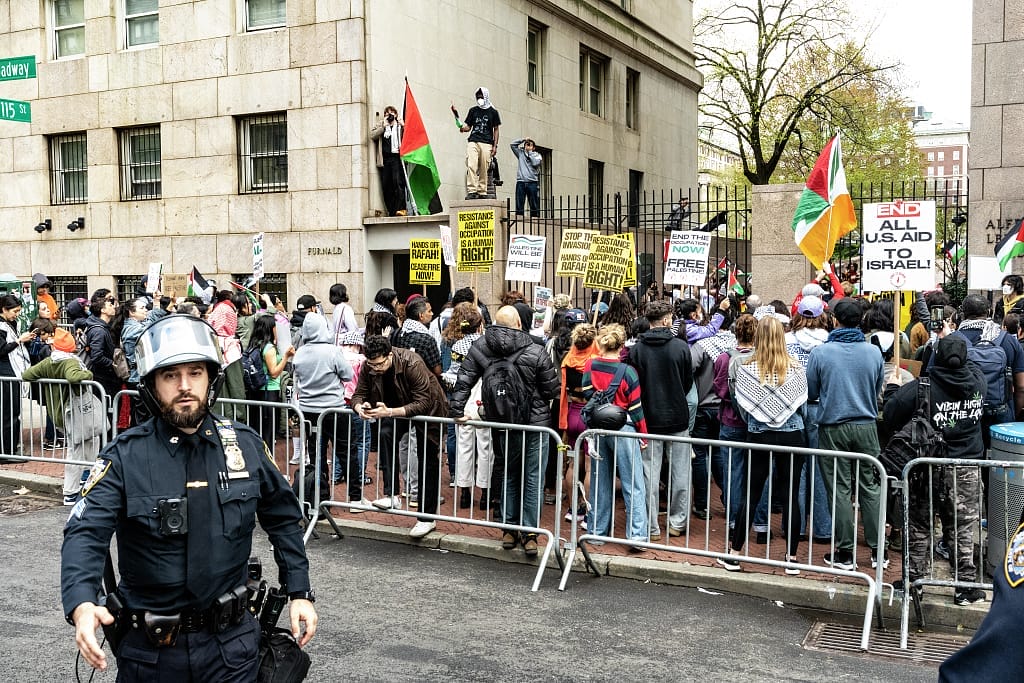
I think universities have allowed a mistaken assumption to take hold: the idea that protests are the same thing as exchanging ideas. You see it all the time. A group protests, another group counter-protests, and the two sides end up shouting at each other while holding placards. Then it all gets posted on social media, and people say, “Look, that’s Americans exercising their First Amendment rights.” And that’s fine. But the problem is this: none of that is actual debate.
Universities have allowed a mistaken assumption to take hold: the idea that protests are the same thing as exchanging ideas.
That isn’t people trading reasons or engaging in genuine dialogue. What I wish universities would do, when these protest clashes happen, is follow up by saying, “It’s clear there are strong views on all sides of this issue. Let’s sponsor a debate and bring in articulate, well-informed speakers who can model real dialogue for students.” Too often, universities never take that next step. They simply weather the protest and then move on to the next thing.
We need to help students develop the skills to disagree constructively while continuing to converse, listen, and make reasoned arguments.
We’re also seeing polling that shows younger Americans are increasingly willing to endorse political violence as a way to achieve their goals. We recently saw this mindset surface in Virginia, where the Democratic candidate for attorney general privately said he wanted the former speaker and his children killed to drive political change. The data suggests this trend is especially pronounced on the political left. Why do you think that is, and how should we understand this shift?
Skultety: Yes. I think two things are going on. I’ll start with what might seem like the superficial explanation and then move to what I think is the deeper one. The superficial point is this: students are being taught and trained in ways that make political violence seem acceptable. Many are reading Marx, Frantz Fanon, Michel Foucault, and similar thinkers. Those writers consistently suggest that, in the face of certain forms of injustice or inequality, it is permissible to shut down dialogue and debate and instead act, including violent action. So, in that sense, the superficial answer is simply: what else should we expect if students are constantly exposed to the idea that this is how you bring about change?
Here’s what I think is the deeper point. Our Constitution was designed as a system for managing disagreement. It’s a mechanism that allows people to contend with one another in the realm of ideas and policy. In that sense, the Constitution is a pro-conflict, pro-struggle, pro-debate document. Its checks, balances, and separations of power all signal that we have a normal, structured way to handle conflict together. The original Constitution essentially told Americans: you must be prepared to engage in ongoing political conflict, because that is how our system works. What I think happened, starting with the progressives in the late 19th and early 20th centuries, is that they argued that the Constitution was outdated — perhaps suitable for its own era, but no longer adequate. In their view, we needed a government that functioned like a well-oiled machine, guided by experts and technocrats who could run things efficiently. But that model of an efficient machine does not celebrate conflict, contestation, or struggle. In fact, once you treat government as a machine, any sign of conflict starts to look like a problem.
And here’s the final piece. If you stop teaching people about the Constitution, if you tell them instead that government should function as a big, orderly machine, then young people eventually conclude that the machine isn’t working. It isn’t producing what it’s supposed to produce. And in that model, there’s no place for normal political conflict or healthy disagreement. There’s no built-in outlet for acceptable forms of struggle.
So when the machine breaks down, they assume the only way to fix it is to tear down the whole system. That leads to a kind of civil-war mentality, a belief that violent action is the only remaining option. In that sense, the progressives unintentionally sowed the seeds for why young people on the left, who mainly encounter progressive ideas, can come to feel that there is no alternative. They think violence is the only path to change because they haven’t been taught the constitutional way of handling conflict.
The American founders also lived in a world of deep disagreement, yet they built a political framework capable of channeling that diversity into self-government. Even at the founding, there were profound disputes, including over slavery, and we sometimes forget how divided they truly were. Still, they shared a commitment to certain virtues that made dialogue and debate possible. What lessons can students today, especially young people who want a more open exchange of ideas on campus draw from the founding experience to foster healthier dialogue?
Skultety: Yes, that’s a great question. The basic point is this: the only way to hold our country together, to improve the common good, and to move toward a more perfect union is by strengthening our habits of talking with one another, disagreeing with one another, and muddling through together. And there’s nothing natural about that. If you’ve never been in a real disagreement or debate, your first instinct is to get angry, take a cheap shot, or simply shut down. Virtue, in this sense, is the habituation of our nature so that we aim at better ends than we would reach on instinct alone.
Learning how to handle disagreement requires developing certain virtues and managing our anger and emotions, learning to follow someone else’s argument, and then formulating our own. None of that is easy. And the founders understood this because, as you said, they were hardly in lockstep about anything. They lived with deep disagreements on countless issues, and it was extraordinarily difficult to produce the documents that have framed the American experiment ever since.
Take the Constitutional Convention. It still amazes me: the delegates weren’t even sent to Philadelphia to write a new Constitution. They were supposed to patch up the Articles of Confederation. It shocked people back home that an entirely new framework came out of that meeting. Think about the level of conflict, disagreement, and argument required to make that happen. The Federalist Papers themselves exist because the new Constitution was so controversial that Madison, Hamilton, and Jay felt compelled to publicly defend it and persuade their fellow citizens through reasoned argument.

None of this was easy. And that, I think, is the great lesson of the founding for students today: if you want to make a difference in political life, you have to cultivate the virtues needed to endure a long, difficult process — one that challenges you emotionally as much as intellectually. The founders model a willingness to argue, to explain themselves, to debate fiercely, and to keep working together despite deep disagreements. That’s the habit we need to recover.
With that in mind, do you sense a hunger among college students to revisit our founding documents and rediscover those fundamental principles? As someone teaching on a college campus, do you see a renewed appreciation for the founding today?
Skultety: I think there is real interest. To give you a quick snapshot: when we first offered our Freedom Studies classes last spring, 26 students signed up. The next semester, 65 signed up. The semester after that, 135. And now we’re approaching 150. And that’s all without much advertising — this was before we even had our social media presence in place. It’s almost entirely word of mouth. So yes, there’s clearly a growing hunger among students to take these courses.
But I think the fuller answer is “yes, but.” Students are interested in exploring the founding principles, but they also want to know why those principles were neglected for so long — and why they didn’t prevent some of the problems they’re seeing today. They aren’t hostile to the founding, but they do want an explanation of why these ideas are still relevant if, by themselves, they didn’t keep the country on the right track.
So, it’s not just a matter of reminding students of the principles; it’s showing them how those principles were applied in difficult historical moments to confront real problems. Once they see that, the ideas become much more compelling. They begin to recognize the serious challenges in their own lives and see how these principles might help them navigate those challenges. In other words, you have to make the problem visible before they can get excited about the solution.